
Credentials are not configuration
A production API key is often introduced as a line in a deployment manifest: inject an environment variable, grant permissions, ship. That framing is convenient, but wrong in an important way. A key is not static configuration. It is a security-sensitive resource whose validity, owner, permissions, and replacement process change over time.
Credential lifecycle management is the engineering discipline of managing those changes deliberately. It covers creating a credential, recording who owns it and what consumes it, distributing it, monitoring it, replacing it, invalidating it when necessary, and retiring it. The term applies to API keys, tokens, passwords, certificates, signing keys, and other secrets. NIST uses a more formal state model for cryptographic keys; the broader operational lesson still applies: state transitions need to be intentional and recorded. NIST’s key-management guidance
This is timely because OpenAI’s Python SDK v3.11.0 added expiration controls for service-account keys on September 9, 2026, while the Node SDK v7.13.0 added API-key expiration controls. Those are product features, not a complete security architecture—but they make credential lifetime an explicit integration choice rather than an invisible platform default. Python release Node release
Plain English: A credential is not a value you set once. It is a dependency with a birth date, an owner, a useful lifetime, and a plan for replacement or emergency shutdown.
That matters especially for AI systems. Agents, background workers, CI jobs, retrieval pipelines, and tool integrations can run without a person present to notice that a key is stale, leaked, or about to expire. If authentication fails halfway through an unattended workflow, the failure is operational. If a broad, long-lived key leaks from that same workflow, the blast radius is operational too.
The lifecycle, step by step
Start by treating each credential as a managed resource, not a string. Its authoritative record should answer simple questions: Who owns it? Which service or workload uses it? What is its authorization scope? When was it created and activated? When does it expire? Is it current, being replaced, suspended, revoked, or destroyed?
The record does not need to live in a bespoke database. It may be represented across an identity provider, a secrets manager, infrastructure configuration, and an asset inventory. What matters is that an engineer can establish the current state without reconstructing history from tickets and environment variables.
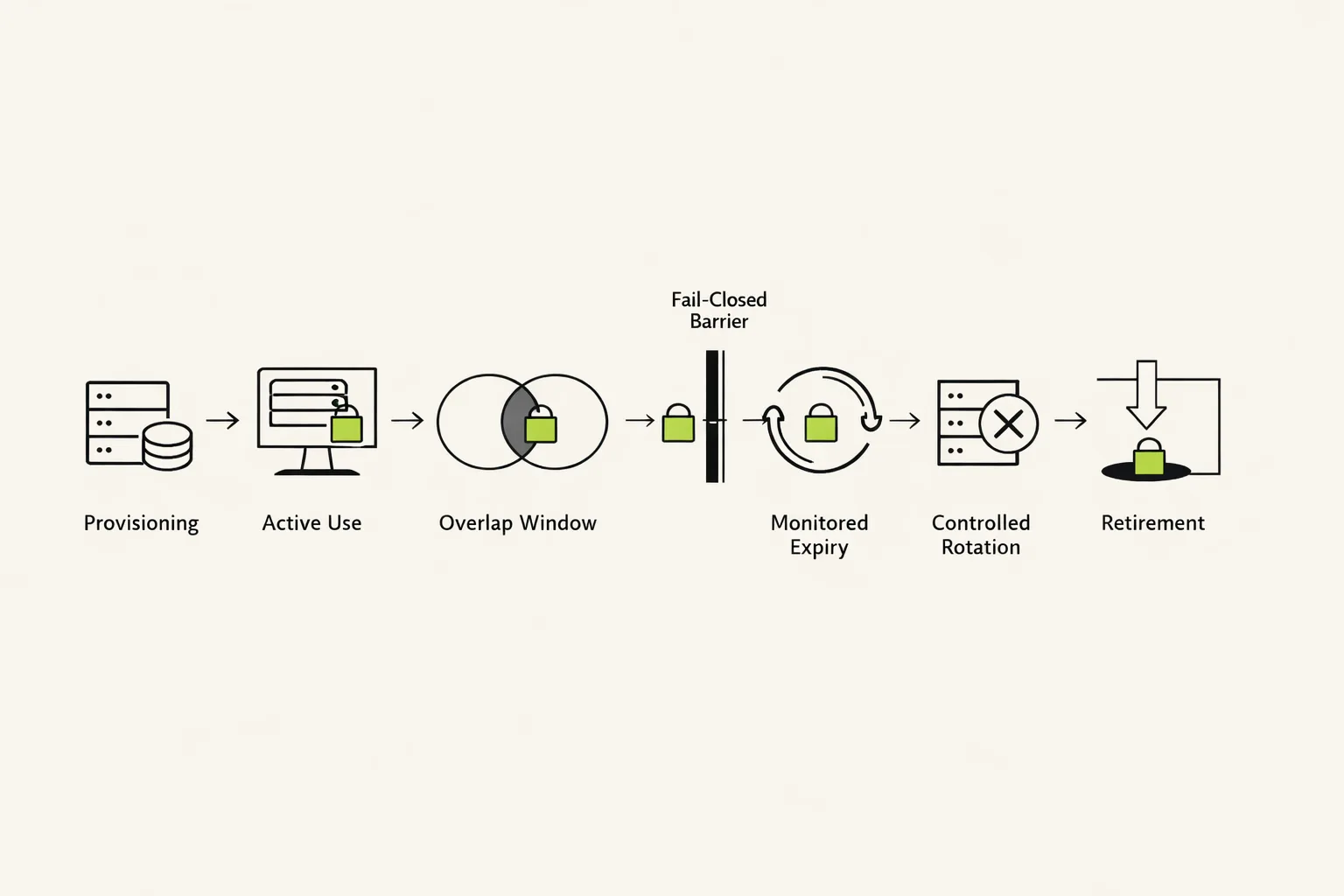
A useful lifecycle has several explicit transitions:
- Provision and activate. Create a credential with a named owner, a consumer, and the smallest practical scope. Give it a validity window where the provider supports one.
- Distribute and use. Deliver it through the approved runtime path rather than source control. The OpenAI Python SDK documentation, for example, recommends keeping API keys out of source control and documents credential-refresh patterns. OpenAI Python SDK
- Monitor. Track approaching expiry, failed authentication, unusual use, and whether consumers have adopted a successor.
- Rotation. Replace the active value with a successor through a controlled cutover.
- Revocation or expiry. Invalidate the old credential on schedule, or immediately if compromise or decommissioning demands it.
- Destroy and audit. Remove residual copies where possible and preserve the lifecycle record needed for investigation and compliance.
OWASP describes secret lifecycle management as including creation, rotation, revocation, and expiration, and recommends defined expiration where possible. It also draws a practical distinction between expiration that a consuming system actually enforces and metadata that merely tells a supporting process when to rotate. OWASP Secrets Management Cheat Sheet
That distinction is easy to miss. Expiration is a validity boundary: after a point, the old credential should no longer work where enforcement exists. Rotation is a replacement procedure: a new credential exists, consumers obtain it, workloads reload it, traffic succeeds, and only then can the old one go away. One without the other produces different failures.
Plain English: Expiry answers “when must this old key stop working?” Rotation answers “how does every legitimate workload move to the new key without breaking?”
A safe rotation therefore needs a protocol. First provision the successor. Then make it available through the normal secret-delivery mechanism. Next, make clients reload or refresh it. Validate real requests with the new credential. Finally revoke the predecessor and verify that it is rejected. Some providers permit two valid credentials for a bounded overlap window; that can make cutover safer, but it also means two usable values exist temporarily and both must be monitored.
What this is—and is not
Credential lifecycle management overlaps with secrets management, but the terms are not interchangeable. Secrets management is the broader machinery for storing, provisioning, access control, auditing, and detecting sensitive values. Lifecycle management focuses on the state and policy of the credential from creation through retirement.
It is also broader than rotation. Rotation is one operation in the lifecycle. An organization that rotates a key every 30 days but cannot identify its owner, revoke it in an incident, or tell which deployment still uses it does not have a healthy lifecycle.
Nor is it a substitute for authorization design. Scope controls what a credential can do; lifetime controls how long it remains usable. A narrowly scoped credential can still be dangerous if it lives indefinitely. A frequently rotated credential can still be dangerous if it grants broad access.
Finally, do not apply cryptographic-key guidance mechanically to every bearer token or vendor API key. Providers differ on whether they support overlap, introspection, immediate revocation, expiry enforcement, or runtime refresh. Your design has to follow the actual protocol, rather than a generic diagram.
A realistic engineering example
Consider a hypothetical code-review agent running in CI. It reads pull-request metadata, calls a model API, fetches permitted repository context, and posts a review. Its service credential is currently injected as a long-lived environment variable. This works until the day it does not: the credential is copied into a debugging environment, a replacement is generated manually, and nobody can be certain which runners still hold the old value.
A lifecycle-oriented redesign starts with a policy, not a new vault. The team assigns an owner, records that the credential is only for the review-agent workload, defines its scope, and sets a maximum lifetime supported by the provider. Infrastructure checks reject a deployment that lacks an owner, has an excessive lifetime, or has no documented rotation path.
The runtime then needs a failure plan. If the authentication mechanism supports refresh, the worker fetches a successor through its normal identity path and uses it for subsequent calls. If it cannot refresh safely, it should fail closed: stop privileged work and report an actionable authentication failure rather than continue with an unintended fallback. The release process rehearses the full path: create successor, distribute, reload workers, verify successful requests, revoke predecessor, and confirm rejection of the stale value.
The point is not to turn every key change into a ceremony. The point is to make the inevitable change routine before it becomes an incident.
Workload identity changes the shape of the problem
Workload identity is an authentication architecture in which software obtains short-lived tokens from an identity provider instead of carrying a long-lived static API key. The OpenAI Python SDK documents workload-identity authentication using short-lived cloud-provider tokens as an alternative for automated environments. In its documented X.509 mode, tokens are cached and refreshed automatically; certificates, private keys, passwords, trust configuration, and rotation remain application and transport concerns. OpenAI Python SDK
This can reduce the number of long-lived values distributed to workloads. It does not remove lifecycle work. It shifts it toward identity-provider availability, token exchange, certificate stores, clock synchronization, trust stores, and network dependencies. Treat it as a different failure model, not as an automatic upgrade from “secret problem” to “no secret problem.”
Plain English: Short-lived tokens can shrink the damage from a leaked static key, but they add dependencies that must also be monitored, rotated, and tested.
Where designs break
The common failure is thinking that an expiry date solves credential management. It does not. Expiration limits the maximum useful lifetime of an exposed credential, but it cannot prevent misuse before the deadline. It can also cause an outage when a consumer cannot fetch a replacement, reload configuration, or tolerate time skew.
Another failure is silent fallback. A client that cannot refresh a credential and quietly uses an older one defeats the policy and conceals the incident. A third is unbounded overlap: keeping old and new keys valid “for safety” until nobody remembers which one should be removed.
AI systems add one more reason to be strict about boundaries. A persistent agent workspace may contain files, command output, artifacts, and resumed work. OpenAI’s sandbox-agent documentation describes those persistent workspaces, and its sandbox boundary guidance treats host-path materialization, traversal, archive extraction, and symlink swaps as filesystem trust-boundary concerns. Sandbox Agents documentation Sandbox runtime boundary Do not assume a credential is safe merely because it was injected into an “isolated” agent environment. The path by which files and secrets enter, persist, and leave that environment is part of the threat model.
What a senior engineer can do this week
First, inventory one agent or automation workflow. Identify every credential it uses, the owner, consumer, scope, expiry behavior, revocation path, and replacement path. Unknown answers are design work, not documentation debt.
Second, turn one rotation into an automated, observable runbook. Test it in a non-production environment under a realistic condition: an old credential is accepted, a successor is introduced, workers reload, the predecessor is revoked, and stale requests fail predictably.
Third, add lifecycle checks to deployment review. A credential without ownership, an explicit scope, a reasonable maximum lifetime, or a recovery plan should be treated like an unreviewed network exposure.
Finally, add evaluation for failure behavior, not only successful calls. Your system should demonstrate that expired and revoked credentials are rejected, that refresh errors are visible, and that privileged tasks stop safely when identity cannot be established.