
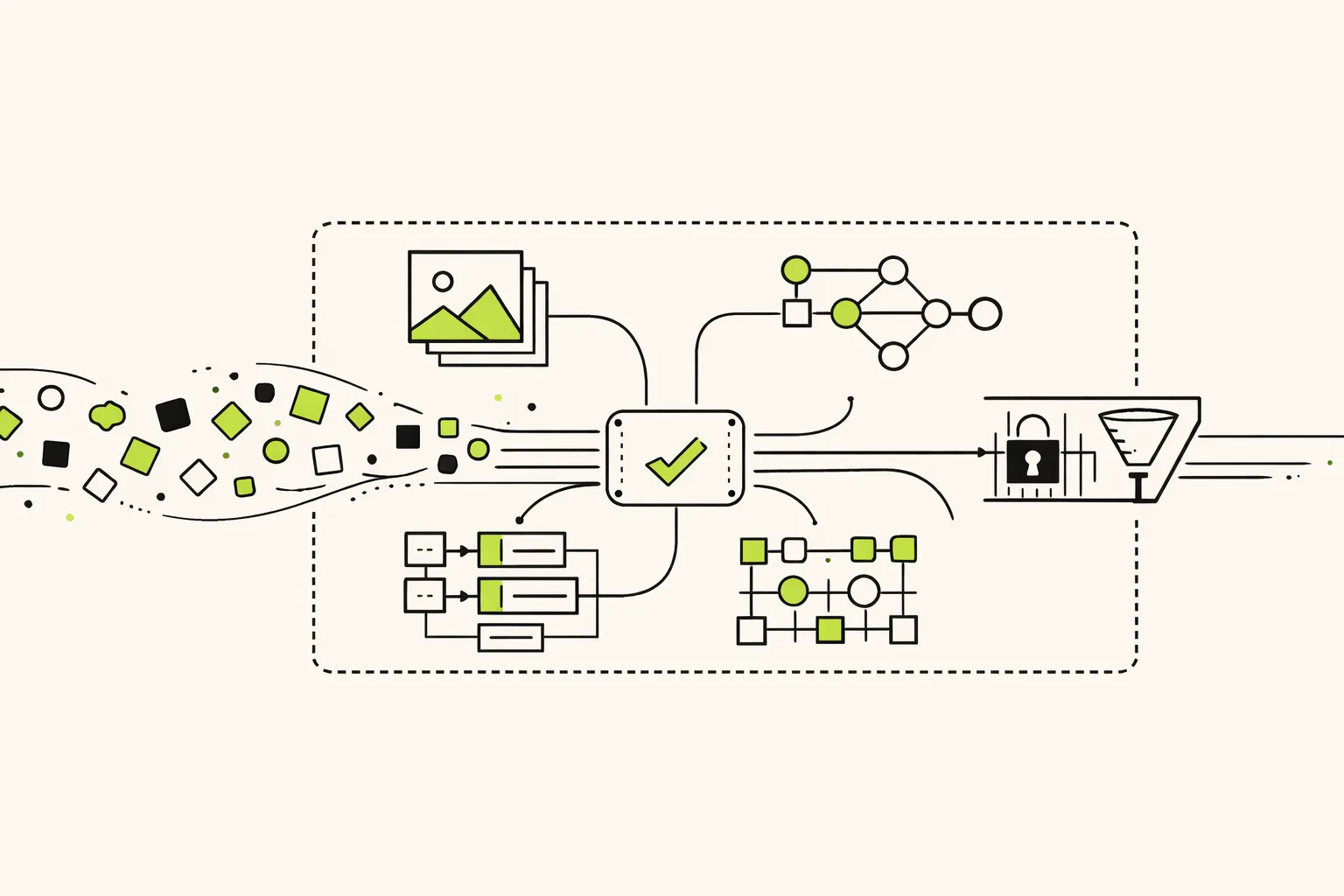
A tool-using model does not hand your application a clean function call. It emits tokens: a stream that may contain ordinary text, reasoning markers, a tool name, structured arguments, and malformed or incomplete fragments. Treating that stream as prose with a little JSON embedded in it is a tempting shortcut. It is also where agent systems quietly become unreliable.
Protocol-aware output parsing is the discipline of treating generated output as a protocol at the inference boundary. Instead of asking, “Can we find JSON somewhere in this response?”, it asks what each part of the stream means, what state the response is in, and whether the transition to a tool request is complete enough to act on. The parser identifies regions such as reasoning, visible content, a tool-call envelope, a tool name, arguments, and end-of-message; it then converts them into one application-facing representation.
That distinction matters because text formatting becomes control flow as soon as a model can invoke a database query, deploy infrastructure, or send a message. A parser that mistakes a tool call for reasoning may cause an agent to stop. One that mistakes an incomplete argument for a finished request may execute too early. One that silently guesses can turn a model-format change into an incident.
Plain English: A model response is not merely text to display. If it can trigger an action, it is an input protocol that needs the same care as any other untrusted control input.
Why this matters now
The immediate example comes from llama.cpp’s Ling 3.0 support. A reported failure occurred when the model emitted a <tool_call> marker before it closed its reasoning block. The generic parser put the whole turn into reasoning_content, leaving no usable tool call for the agent loop. The result could be an empty content field and a stopped workflow rather than a tool invocation. The issue report documents that failure mode.
Release b11057 added a dedicated Ling 3.0 parser. It treats the beginning of a tool call as an implicit end to reasoning when the expected reasoning-close marker has not arrived, and the release notes say it added tests for unclosed-think tool calls and streaming behavior. That is a narrow fix for one format, but a broad systems lesson.
The lesson is not that every team needs a custom parser for every model. It is that model output has a compatibility surface. Checkpoints, chat templates, runtime versions, and model families can use different delimiters and different orders for the same apparent concepts. The more your runtime hides those differences behind one tool API, the more seriously it must take parsing and tests at that boundary.
This is also why streaming parsing deserves attention. In a non-streaming response, code can wait for the final bytes and parse once. In a streamed response, it has to distinguish “not yet enough information” from “this is invalid.” Those are different states. Confusing them produces premature UI updates, truncated tool arguments, or tool-name matches that change when more tokens arrive.
Plain English: Streaming does not mean “parse each chunk independently.” It means preserve state across chunks and wait until the protocol says an action is complete.
How the boundary works
A robust implementation starts by writing down the output protocol, even if the model vendor never did. Define states such as reasoning, visible content, tool-call envelope, tool name, arguments, and terminal state. Define markers that enter and leave each state. Most importantly, define what happens when the expected order is broken: does a tool-call marker end reasoning implicitly, create a protocol error, or remain visible text?
Next, consume generated tokens incrementally. The parser maintains state rather than repeatedly applying a regular expression to the accumulated string. A parser combinator is one way to build this: small parsers for literals, alternatives, sequences, and nested values can be composed into a grammar while retaining explicit state and lookahead. A PEG parser, short for Parsing Expression Grammar parser, is another useful approach for expressing ordered alternatives and unambiguous matching. llama.cpp’s auto-parser can analyze rendered chat-template variants, identify markers for reasoning, content, and tools, and generate a PEG parser and, optionally, a grammar. Its architecture documentation describes that process.
The parser should emit semantic regions, not just string slices. Semantic tags attach a category such as content, reasoning, tool name, or argument to parsed material. The runtime can then perform normalization: map several model-specific surface formats into a stable internal shape, for example content, reasoning_content, and tool_calls. llama.cpp documents support for partial stream parsing, built-in JSON parsing, and AST generation with semantic tags; it also describes content-only output, JSON-style calls, and formats where tool arguments are separate entities such as XML or pseudo-function calls. Those formats are exactly why a single JSON extractor is insufficient.
Only after a complete call has been normalized should the runtime parse the arguments and apply schema validation. Schema validation checks that data has the expected structure and types. It cannot tell you whether delete_project is appropriate, whether the caller is authorized, or whether a valid-looking identifier targets the right tenant. Those are later checks, owned by policy and tool dispatch.
Plain English: First decide what the model emitted. Then verify that the arguments have the right shape. Only then decide whether the requested action is allowed.
This order matters. Tool calls are requests, not authority. Parsing establishes that the model made a complete request; authorization establishes whether it may use that capability; execution performs the side effect. Folding those responsibilities into one “parse and run” step makes defects difficult to observe and harder to contain.
What it is not
Protocol-aware parsing overlaps with several useful techniques, but it does not replace them.
It is not constrained decoding. Constrained decoding limits what the model may generate, often by enforcing a grammar or JSON structure during generation. It can reduce malformed output, but it does not remove the need to interpret model-specific reasoning and tool markers, manage partial streams, or handle old and unconstrained models. Use both where you can: constraints reduce the input space; parsing handles the protocol that arrives.
It is not ordinary JSON parsing. JSON parsing begins after you have reliably located a complete JSON value. A model may produce XML-like wrappers, pseudo-function syntax, multiple calls, or a tool call interleaved with other categories. The boundary parser decides which bytes are arguments in the first place.
It is not chat-template rendering. A chat template builds the prompt and generation context; output parsing interprets the reply. These operations can be related—llama.cpp’s auto-parser examines template variants—but they solve opposite directions of the exchange. A template is not proof that a model will obey the expected response framing.
Finally, it is not a reason to expose raw reasoning to users. The runtime can keep reasoning, visible content, and action requests as distinct semantic categories. Product policy can then decide what to retain, display, or discard without forcing the tool executor to infer meaning from presentation text.
A practical engineering example
Imagine an internal release assistant with two tools: get_deployment_status and roll_back_release. The model is allowed to inspect deployment state, but a rollback also requires a policy check and an approval step. The assistant streams its response to a UI while it prepares a call.
A fragile implementation looks for the first occurrence of a tool marker, grabs text until the next marker, calls JSON.parse, and dispatches. It fails if the tool name arrives as roll_back_ and later becomes roll_back_release; if the JSON object spans chunks; if a marker-like sequence appears inside a string argument; or if the model begins a tool call before closing a reasoning region.
A protocol-aware implementation instead keeps an explicit state machine. It emits visible text only from the content state. It holds a candidate tool call until its envelope, name, and arguments are complete. It validates arguments against the selected tool’s schema, records the raw stream and parse result for debugging, and sends the normalized call to an authorization layer. That layer may allow status reads immediately but require an approval token for rollback. An end-of-stream while arguments are unfinished is a protocol error, not an invitation to repair and execute a guess.
The point is not to make parsing elaborate for its own sake. It is to make every irreversible transition explicit. In this example, the tool executor never sees half-formed text, and the UI never has to retract an already-presented “call” when later tokens change its meaning.
Where it breaks
No parser can create a stable protocol when the underlying model does not provide one. Formats can change across checkpoints, quantizations, templates, and runtimes. Automatic extraction from templates can help, but unusual formats still need model-specific handlers and compatibility tests. The Ling 3.0 fix is a concrete reminder that a generic interpretation can be wrong even when it works for many neighboring models. llama.cpp’s release added a dedicated parser rather than relying solely on the generic path.
Ambiguous markers are another problem. Tool names with shared prefixes, nested structured arguments, and delimiters embedded in quoted strings all demand stateful parsing. llama.cpp’s tests explicitly cover incremental parsing and avoid recognizing a shorter tool name before a longer name has fully arrived. That is an important test property, not an implementation detail.
There is also an unavoidable latency trade-off. Early emission makes an interface feel responsive, but tool dispatch must wait for enough evidence. Choose different thresholds for different consumers: a UI may receive confirmed visible text as it arrives, while a side-effecting tool receives only a fully parsed, schema-valid request.
And parsing is never authorization. A perfectly parsed call may still violate a business rule, exceed a resource limit, or be unsafe in the user’s current context. Treat parser success as a necessary condition for execution, not a sufficient one.
What you can do this week
Start with an inventory. For every model that can request a tool, collect real streamed transcripts: normal calls, no-call answers, multiple calls, malformed arguments, truncated responses, marker-like values inside strings, and calls that appear before an expected reasoning terminator. Include model and template version in each fixture.
Then make the intermediate representation explicit. Your inference adapter should return categories such as visible content, reasoning, candidate tool call, completed tool call, and protocol error—not one overloaded text field. Keep the raw response alongside the normalized representation in a controlled debug path, with the retention policy appropriate to your environment.
Finally, test the boundary at token granularity. Run each fixture as a complete buffer and one token or small chunk at a time. Assert that the final result is identical where it should be, that no incomplete request reaches dispatch, and that an ambiguous prefix is not treated as a complete tool name. These tests are especially valuable before model, template, or inference-runtime upgrades.
The practical standard is straightforward: when generated text can cause an external effect, output framing belongs in your correctness model. Treat it as a versioned protocol, parse it deliberately, and fail closed when the stream does not prove what it means.