
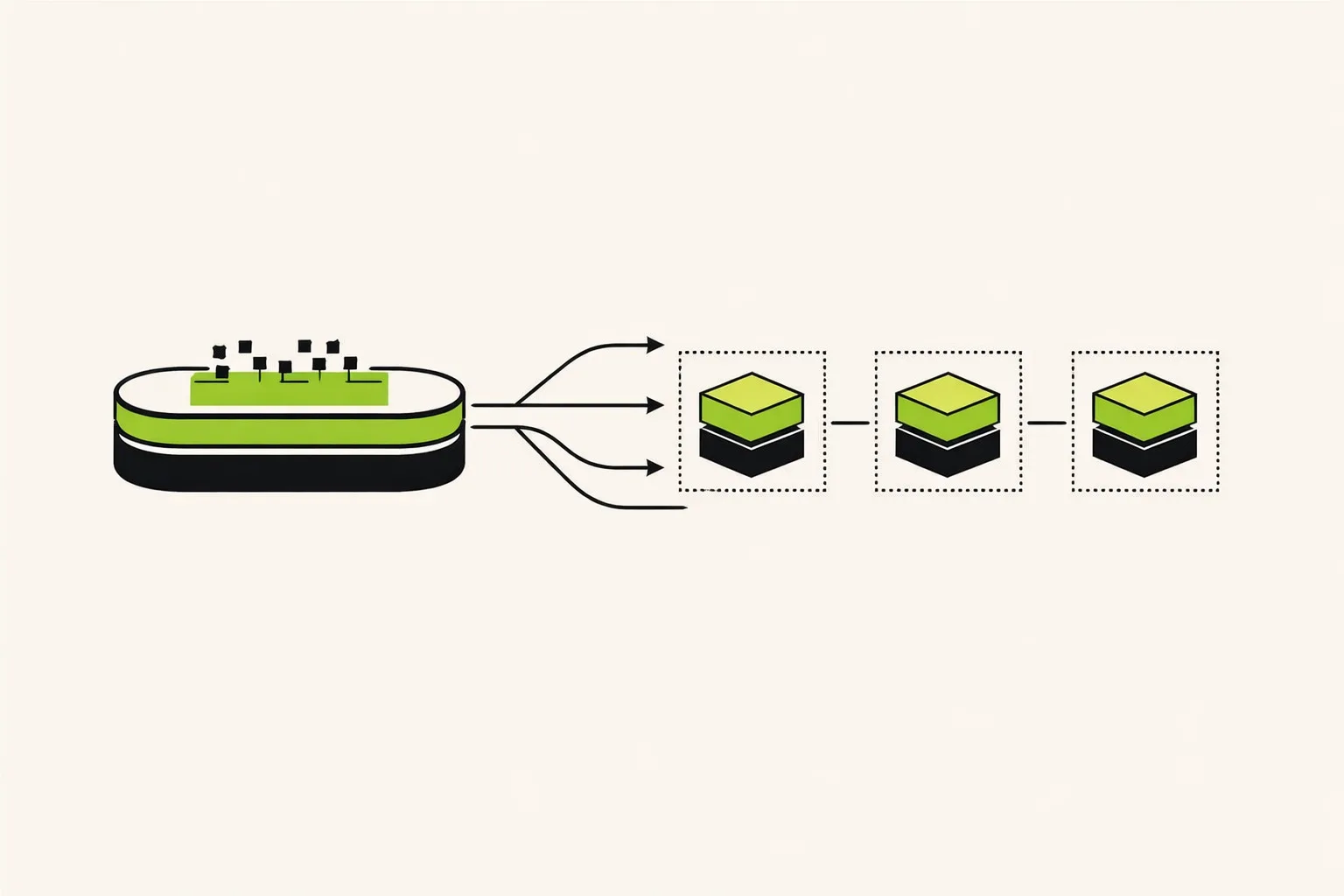
Long-running agents expose an infrastructure problem that ordinary request handlers can often hide. An agent may need a large dependency graph, model artifacts, static configuration, and tool setup before it can do useful work. If every new isolated session repeats that preparation, startup time and resource use become part of the product experience.
AWS’s AgentCore Runtime V2 is a timely example. It prepares an environment once, captures a snapshot, and restores that prepared state for new instances rather than rerunning initialization. AWS reported P75 cold-start latency of roughly 1.9 to 2.0 seconds for 200 MB through 2 GB images in its own test setup; that is a product-specific measurement, not a general guarantee. AWS’s announcement matters less for the number than for the architectural choice behind it.
A descriptive name for a useful pattern
Snapshot-based execution is a runtime pattern: initialize a process or environment once, capture a restorable representation of that initialized state, then create later instances by restoring it. The practical goal is to move reusable startup work out of the steady-state launch path.
The name is deliberately descriptive, not a universally standardized term. Systems engineers may call the broader underlying technique checkpoint/restore; product documentation may say snapshotting, restore, or warm-start snapshots. Here, “snapshot-based execution” means the specialized production pattern of reusing one deliberately prepared baseline to launch many instances. Checkpoint/restore is broader: it can also preserve a running workload for migration or recovery.
Plain English: Do the expensive, repeatable setup once. Save the prepared starting point. New workers begin from that point instead of rebuilding it.
That distinction matters because a snapshot is not just a faster container launch. A container image packages filesystem content and launch metadata. A runtime snapshot can capture live initialized state: loaded code, process memory, and other runtime resources that can be reconstructed. Starting an image still runs the application’s boot path; restoring a snapshot aims to bypass much of that path.
Why agents make the pattern relevant now
An agent is not simply model inference behind an HTTP endpoint. It commonly combines a model call with state, a Tool interface, orchestration, policy checks, and session handling. Some sessions are interactive; others continue unattended. They may arrive in bursts, pause, resume, or need isolation from one another.
That workload shape makes initialization variance costly. A warm pool addresses it by retaining already-running workers. It can provide quick assignment, but idle capacity remains resident and must be sized ahead of demand. Snapshot-based execution instead stores a compact prepared baseline and restores instances when needed. It trades permanently resident spare capacity for preparation, storage, restoration, and careful state design.
AgentCore V2 also illustrates a related point: startup time is not determined only by image size. AWS says the runtime prepares an environment and captures a snapshot, while its architecture uses on-demand memory allocation and reclamation rather than holding a session’s peak allocated memory for its full lifetime. Its runtime announcement describes that implementation. The portable lesson is not that every platform will behave identically. It is that startup, memory lifetime, isolation, and session duration deserve explicit architecture decisions.
The state boundary is the design work
The simple story—initialize, snapshot, restore—hides the hard question: what is safe to put in the snapshot? The answer is a state boundary, the line between data that remains valid for the snapshot’s useful lifetime and data that must be created after an instance is restored.
A useful sequence looks like this:
- Build a versioned deployment and run stable initialization. Load dependencies, static configuration, and reusable artifacts whose values are valid for the lifetime of that version.
- Capture the initialized environment as a runtime snapshot. AgentCore documents this prepare-then-restore model for Runtime V2. Its runtime guide also ties snapshots to runtime versions and endpoints.
- Restore a new execution instance when demand arrives.
- Perform instance-specific and request-specific work after restore: establish identity, obtain current authorization material, read dynamic configuration, generate fresh randomness, and bind the session.
- Retire snapshots with the deployment lifecycle. AgentCore retains old snapshots while existing sessions can still use them, then removes snapshots once they are no longer referenced. The lifecycle details are documented here.
Plain English: A snapshot may contain what is stable. It must not quietly preserve something that should be new, current, or unique for the next session.
AWS’s optimization guidance makes this boundary concrete: it separates startup work stable for a snapshot’s lifetime from request-handling work that changes or expires. The guidance is platform-specific, but the question applies anywhere: if the process were copied right now, which values would become wrong or duplicated?
Credentials are the obvious example. Capturing an expiring credential can give every restored instance an already-stale secret. Capturing a generated identifier can cause collisions. Capturing a dynamic tool catalog can make a new session operate on an outdated view. Time, random values, session identity, external connections, and data read from a mutable service should be treated with the same suspicion unless their semantics are explicitly understood.
What this is not
Snapshot-based execution is not ordinary caching. A cache stores reusable data, and application code rebuilds execution around it. A snapshot restores a larger slice of the execution environment. It may contain cached data, but its defining property is that it restores prepared runtime state rather than merely returning a value.
It is not an excuse to make a giant startup phase. Preparation has a cost and a lifecycle. AgentCore documents that V2 creation and updates can take several minutes, and initialization must complete within its health-check window. That operational constraint changes deployment behavior: a bad initialization path can fail before production traffic even reaches it.
Nor does restore erase all latency. Networking, routing, external authentication, current configuration, and request-specific state still happen afterward. And not every resource can be recreated safely. A live connection, device handle, or kernel-dependent resource may require reconnection or may not fit the mechanism at all. The architecture succeeds by making these boundaries visible, not by pretending they disappear.
Example: an isolated repository-analysis agent
Consider a hypothetical internal agent that reviews a repository after a pull request opens. Every job needs the same language parsers, policy rules, dependency graph libraries, and static organization configuration. The job itself needs a fresh repository revision, a user or service identity, current policy entitlements, a unique trace, and potentially current findings from external systems.
Without snapshots, every job starts a container, imports parsers, loads rules, builds reusable indexes, then begins the actual review. With snapshot-based execution, the team can load the parsers, static rules, and immutable configuration during preparation. Those become the baseline. On restore, the worker obtains current credentials, creates the trace, fetches the requested revision, reads current entitlements, and then runs the review.
The design does not make the repository contents safe to snapshot. It identifies them as per-job state. It also avoids one subtle failure: if the policy engine’s tool catalog can change, freezing that catalog into a snapshot may produce an agent that calls tools according to old rules. The engineering decision is therefore not “snapshot everything possible.” It is “snapshot only what has a deliberate validity contract.”
A session needs similar care. Session history that must survive a pause belongs in a durable store with explicit ownership and retention rules, not merely in disposable process memory. A restored process can then rehydrate only the session data it is authorized to use.
Plain English: The snapshot is a factory template, not a saved customer job. Keep customer-, request-, and time-dependent data outside the template.
Where it breaks
The most dangerous failure mode is shared stale state. It may not look like a crash. A restored instance can appear healthy while using expired credentials, duplicated identifiers, or old configuration. These failures are difficult because they depend on timing and only appear after deployment, expiration, or a configuration change.
The next risk is confusing a deployment version with a snapshot-compatible version. If initialization behavior, runtime dependencies, or state assumptions change, create and validate a new snapshot rather than assuming the old baseline remains valid. Snapshot lifecycle is part of release engineering, not an invisible optimization.
Finally, measure the right thing. Vendor P75 cold-start figures are useful evidence that an implementation exists, not a capacity plan for your service. Your results depend on snapshot size, restore implementation, storage locality, memory pressure, hardware isolation, and the work you correctly leave after restore. Measure cold and restored launches separately, along with preparation time, post-restore readiness, memory, failure rate, and time to drain old versions.
What you can do this week
Start by drawing your agent’s initialization path. Mark each operation as version-stable, instance-specific, request-specific, or externally mutable. The classification will likely reveal work that belongs after restore even if it is currently convenient at boot.
Then build a small experiment around one costly but safe initialization step. Do not begin with credentials or live connections. Define a test that verifies a restored instance receives fresh identity, fresh randomness, current configuration, and a distinct session boundary. Deliberately rotate a credential and change a dynamic setting between preparation and restore; the restored instance should behave correctly.
Finally, make snapshot readiness observable. Record the runtime version, snapshot identifier where the platform exposes one, preparation duration, restore duration, and the age of the baseline. Treat a snapshot as a deployable artifact with compatibility tests and a retirement policy. That is the shift: startup state becomes something you design, validate, version, and operate.