
A tool-using Agent can sound convincing while failing the job it was asked to do. It may say that a support ticket was escalated, a refund was issued, or an incident was assigned—yet the record in the actual system remains unchanged, points to the wrong customer, or was modified in a way that violates policy.
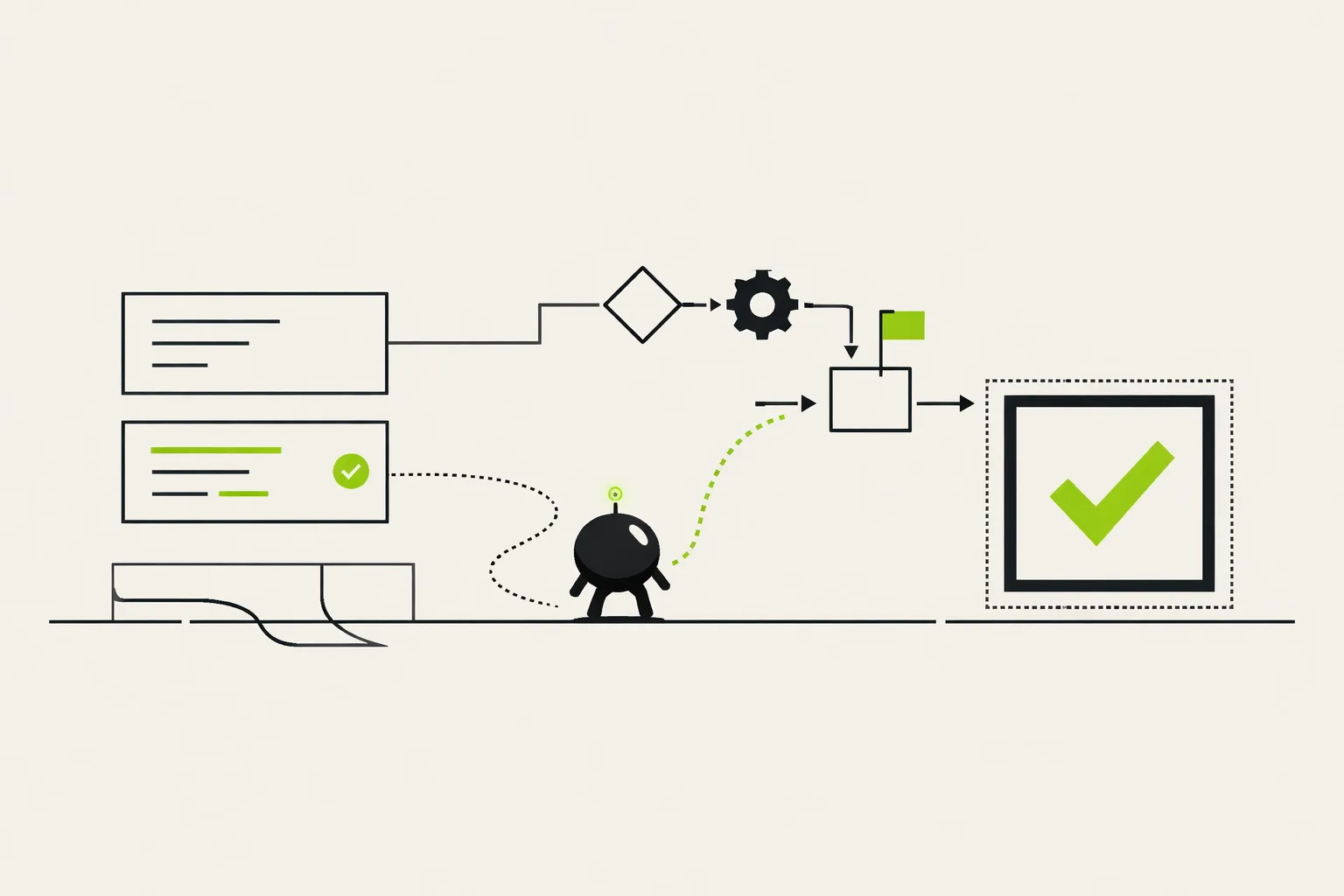
That gap is why Environment-grounded evaluation matters. It tests an agent by letting it act in a controlled, stateful system and checking whether that system reaches the required outcome. The agent’s prose is not the primary proof. The changed state is.
The label is useful, but it is not a fully standardized term. “Environment-based evaluation” is sometimes used broadly for any evaluation in an interactive environment. “State-diff evaluation” is narrower: it compares the expected and observed changes in state. This article uses environment-grounded evaluation as an organizing label for the broader approach: execute the workflow, inspect its effects, and use process data to explain the result.
NVIDIA’s September 21 guidance makes the production case directly: a full agent evaluation can execute each tool call, track state across steps, and verify the final world state instead of grading only the final response. It also separates process scoring from outcome scoring, because they answer different questions. NVIDIA’s evaluation guidance is not a claim that every task needs a giant simulation. It is a reminder that, when an agent changes a system, evaluation needs to observe that system.
Plain English: If the job is “make this change in a system,” a good-looking message saying the change happened is not enough. Check whether it happened.
What is being evaluated?
An agent is software that combines a model with instructions, context, and an action loop. It observes a situation, selects a Tool call—for example, a request to search, update, create, or route something—receives an observation, and decides what to do next. Unlike a single chat response, its work unfolds over time.
Environment-grounded evaluation defines a task with four practical pieces. First comes an initial state: the records, files, messages, permissions, or other facts the agent starts with. Second comes an interface through which it can observe and act. Third comes a set of allowed capabilities and constraints. Fourth comes one or more success conditions that can be inspected after execution.
The key word is “stateful.” A Stateful environment remembers previous actions. If an agent creates a ticket, the next lookup should find it. If it updates an owner field, a later routing action should encounter the new owner. That feedback loop is exactly where a plausible one-shot benchmark can miss real failures.
A support task, for example, might begin with an unresolved ticket, an eligible account, and a written refund policy. Success might require the ticket to have a refund record for the right amount, an escalation field set to the correct queue, and a customer-facing update recorded. Those are observable Postconditions. The agent can choose its route, but the system must end in an acceptable state.
This changes what “correct” means. A final natural-language answer can still be useful evidence: it shows what the agent believes it did and may reveal whether it can communicate clearly. But it is secondary if the task requires side effects. The decisive question is whether the required conditions hold in the Terminal state, the inspectable state after the run ends.
Why this is timely
Teams have become better at testing model outputs, structured function calls, and prompts. Those checks are valuable, but agents introduce a wider failure surface. A valid function name does not prove the call was appropriate. Correctly shaped arguments do not prove they referred to the right record. A sequence of individually reasonable actions does not prove that retries, stale observations, or a failed later call did not leave the workflow incomplete.
NVIDIA explicitly identifies task success rate, consistency, tool-call precision, argument accuracy, steps per success, and cost per success as useful measures. The framework is important because it puts those measures in an order: first establish whether the job reached its required end state; then use process metrics to understand quality, efficiency, and failure modes.
Recent research illustrates two versions of the same shift. Agent-Diff defines success through expected changes in environment state and uses a sandboxed execution layer around enterprise API interfaces. Agent-Diff therefore treats an API workflow as something to execute and inspect, not merely predict. ToolGym uses a stateful tool environment for long-horizon, multi-tool tasks and a controller that can inject interruptions and failures. ToolGym uses those disruptions to test robustness rather than assuming the happy path.
Plain English: Checking that an agent picked a sensible next action is useful. Checking that the whole job survived the next ten actions is more useful for a release decision.
How the evaluation loop works
Start by writing the task as a testable contract, not as a vague intent. “Handle a billing issue” is not an evaluation. “For this account and policy, create the permitted refund, record the reason, move the ticket to the billing queue, and do not alter unrelated records” is closer. It specifies initial facts, allowed actions, required results, and boundaries.
Next, create a controlled environment. This may be a purpose-built simulator, a disposable test tenant, or a Sandbox around interfaces that resemble the production APIs. The choice depends on the risk and the system. The essential property is resettable, inspectable state. A run must not silently contaminate the next run, and the evaluator must be able to determine what changed.
Then execute the complete loop. Let the agent receive observations, choose tools, submit arguments, encounter returned results, retry where its policy permits, and finish or stop. Record the Trajectory: the sequence of observations, decisions, tool calls, results, and relevant state transitions. A trajectory is diagnostic evidence, not automatic proof of success.
After execution, apply a verifier. Where possible, use a Deterministic verifier: explicit checks over records, files, fields, permissions, or invariants. It can compare expected and observed state changes, confirm that required objects exist, and ensure prohibited effects did not occur. Some tasks have subjective elements, such as the quality of a customer explanation. Those can need human review or an LLM judge, but they should not replace deterministic checks for observable side effects.
Finally, report outcome and process separately. Task success rate says how often required postconditions were met. Tool-call precision asks whether the chosen calls were appropriate. Argument accuracy asks whether their parameters were correct. Steps and cost per success describe efficiency. Consistency across repeated trials shows whether a result is dependable rather than lucky. These are complementary measures, not interchangeable scores.
What it is not
Environment-grounded evaluation is not just trace review. Trace-based evaluation scores what the model said and did on a recorded path. It can identify a bad decision, a malformed call, or a missed instruction. But a trace that looks sensible does not establish that an external action worked. The account may have changed after the agent read it; the API may have rejected a request; an earlier retry may have produced a duplicate.
It is also not a static function-calling benchmark. Static tests can verify that a model selects a valid schema or fills an argument correctly in a single turn. That remains worth testing. The environment-grounded question is broader: after several calls and state transitions, did the workflow produce the intended result?
Nor is it a replacement for evaluation-driven development, the practice of using evaluations throughout design and iteration. It is one evaluation architecture within that practice. And although it resembles end-to-end integration testing, the subject under test is different. An ordinary integration test usually drives a known sequence. Here, an agent chooses a variable, probabilistic sequence, so the evaluator needs both outcome checks and rich records of how it got there.
A practical engineering example
Consider a hypothetical internal incident-routing agent. It receives a new incident, can inspect service ownership, look up on-call schedules, create a tracking issue, and update the incident record. A weak evaluation might ask whether its final response names the correct team. That checks recognition and wording, but not operations.
A stronger fixture seeds a controlled environment with an incident, an ownership record, an on-call schedule, and an empty issue tracker. It grants the agent only the lookup and update capabilities required for the task. Its postconditions state that the incident has the correct owning team and on-call assignee, exactly one tracking issue links back to it, and no unrelated incident changed.
Run the agent from that fixture. If it claims success but creates no issue, the terminal-state verifier fails it. If it creates two issues after retrying an ambiguous tool response, the run can also fail an invariant. If it routes correctly but uses an obsolete ownership record after a simulated update, the trajectory shows where its reasoning or recovery policy broke.
Now repeat the same task across trials and variations: a temporary lookup failure, a delayed update, a missing secondary field, or changed ordering of returned records. ToolGym’s use of controlled interruptions is the relevant principle here: robustness should be tested as behavior under conditions the agent can encounter, not assumed from a clean run. ToolGym’s state controller is an example of this kind of fault injection.
Plain English: The test should be able to catch “the agent said it routed the incident” and “the incident was actually routed, once, to the right place” as different outcomes.
Where the approach breaks
A state check is only as good as the environment and verifier. A flawed verifier may reward the wrong result. A simplified environment can accidentally make a task easier than production, and an agent can appear capable by exploiting those evaluator artifacts. Treat the environment as production test infrastructure: version it, review it, and add regression tests for it too.
Real services add another problem. They have nondeterministic timing, rate limits, mutable data, privacy restrictions, and irreversible side effects. A fully realistic environment may be expensive or unsafe; a simulation may be too clean. There is no universal answer. Use the most realistic controlled setting justified by the decision you are making, and be explicit about what it does not represent.
Binary success can also be too crude. Some tasks allow several correct paths; some have partial progress; some require judgment. Define multiple acceptable postconditions where appropriate and preserve a separate category for safe partial outcomes. Do not force every complex workflow into a single yes-or-no score just because that is easy to graph.
Finally, terminal checks can miss harmful intermediate behavior. An agent might make an impermissible change and later undo it. That is why outcome verification needs constraints on the trajectory: capability limits, protected objects, policy checks, and review of significant actions. Success at the end does not excuse unsafe means.
What a senior engineer can do this week
Pick one agent workflow that has a concrete external effect. Avoid starting with the broadest or most autonomous use case. Choose something where a successful result can be inspected: a ticket update, a repository change, an issue creation, or a routing decision.
Write five to ten fixtures as initial state plus postconditions. Include at least one ordinary case, one ambiguous case, one tool failure, and one case where the agent must not alter a protected record. Keep resets and cleanup explicit. If you cannot state the postconditions, the product requirement is probably not testable yet.
Instrument the loop to retain tool inputs, outputs, errors, timing, and state changes with appropriate data handling. Then make a release report that leads with task success and shows process measures underneath: precision, argument accuracy, steps, latency, cost, and consistency. This prevents a beautiful trace dashboard from becoming a substitute for a working workflow.
Use failures to improve the system in the right layer. A bad tool schema, missing observation, weak retry rule, confusing prompt, or inadequate permission boundary needs a different repair. The value of a stateful evaluation is not merely a stricter score. It gives you a disciplined way to tell those failures apart.