
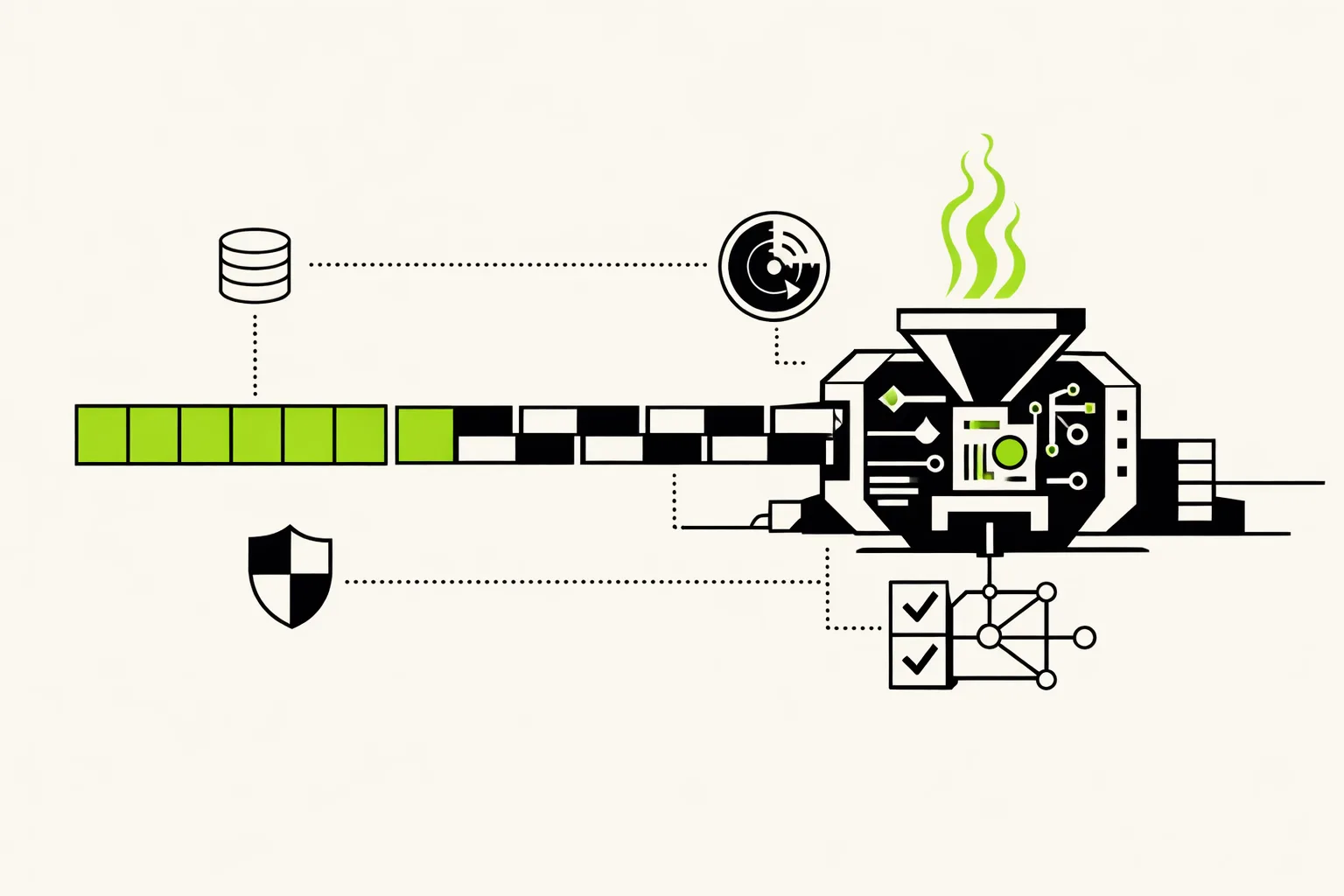
A long-lived agent rarely sends a small, clean request to a model. It sends operating instructions, a catalog of tools, output schemas, policy text, repository excerpts, conversation history, retrieved documents, and finally a user request. Much of that material is repeated. Yet many teams still treat the whole assembled prompt as disposable text.
Prompt-cache architecture is a different approach: design the reusable beginning of an inference request as an explicit application boundary. Put stable material where the provider can reuse it; isolate the material that genuinely changes; then measure whether that layout is delivering cache reads rather than repeated processing. This is an architectural concern, not merely a prompt-writing trick.
The immediate reason to pay attention is that prompt caching is becoming more observable and controllable. OpenAI documents cache-hit monitoring, retention modes, cache diagnostics, minimum cacheable lengths, and explicit cache breakpoints. Its September 22 GPT-6 announcement also frames diagnostics, breakpoints, and prewarming as workload controls. OpenAI’s prompt-caching guide and its GPT-6 update make the operational consequences unusually concrete.
What prompt-cache architecture is
A model processes input as tokens: small chunks of text or structured content. As it reads those tokens, it produces intermediate attention state commonly called a KV cache, short for key-value cache. In prompt caching, a provider preserves that state for an unchanged prompt prefix—the beginning portion of the rendered request. A later request with the same eligible prefix can reuse the existing state, process only the new suffix, and still generate a fresh answer. OpenAI describes this mechanism as reuse of model KV states for an unchanged prompt prefix.
Plain English: Instead of making the model reread the same operating manual on every request, prompt caching lets it resume after the manual—provided the manual is exactly the same.
That word exactly carries most of the engineering work. This is not a system that understands that two instructions mean roughly the same thing. It is a prefix-matching mechanism sensitive to the rendered request and applicable settings. OpenAI specifically documents that tools, structured-output settings, reasoning effort, verbosity, model choice, and context management can affect reuse. Details that look harmless at the application layer can therefore alter cache behavior.
The architecture part is the deliberate arrangement of those details. Stable system instructions, tool definitions, shared examples, and common reference material belong before changing inputs. Timestamps, request IDs, live account state, a user-specific policy override, and the current user message usually belong after the reusable boundary. A cache breakpoint is the provider-visible point at which an eligible prefix can be written and later looked up.
Why it matters now
For a simple chat request, caching may be an implementation detail. For an engineering agent, it can shape the cost and latency profile of the whole system. A coding workflow may repeatedly send a large tool catalog, repository guidance, policy constraints, and a common task template before every action. The more repeated prefill work there is, the more the request layout matters.
This does not mean “make every prompt huge because caching exists.” Cache writes, reads, provider thresholds, retention windows, and pricing all matter. A long prefix with little reuse can be a poor trade. The useful shift is conceptual: repeated context is a shared production asset with a lifetime, an owner, privacy properties, and measurable economics.
That shift also changes how to review a seemingly ordinary change. A modified tool schema may not change agent behavior much, but it can invalidate a shared prefix. A context-compaction change may reduce token volume while destroying reuse across turns. A model migration may alter what can be cached or how it is accounted for. These are deployment effects, not just prompt effects.
Plain English: A prompt change can now behave like a performance change. Review it with the same care you would give a database query or a shared library upgrade.
How it works, step by step
First, your application constructs a request. It may combine system instructions, developer instructions, tools, output requirements, retrieved information, previous messages, and the new input. What matters is the final serialized order, not the conceptual categories in your code.
Second, the provider processes the early tokens and may create a reusable entry when the prefix reaches its requirements. OpenAI documents provider-specific minimum cacheable lengths and controls around breakpoints and retention, so do not assume every prefix is eligible or every request will write an entry. Those controls are documented as operational features, not guarantees of universal reuse.
Third, a later request is compared with the earlier prefix. If the relevant earlier content and settings match, the provider can read the preserved intermediate state and continue with the changed suffix. If an earlier section differs—for example, a reordered tool definition or a new timestamp—the reusable portion may stop at that divergence.
Fourth, the model processes new content and performs inference: generating a new output from the request. A cache hit reduces repeated input processing; it does not retrieve a previously generated answer. Results can still vary, and the current request can still fail for ordinary model, tool, or application reasons.
Finally, your telemetry should show what happened. Track cache reads, writes, misses, effective reusable-prefix length, request latency, and input-cost accounting. Where your provider exposes diagnostics, record why a prefix diverged. This lets a team distinguish “the model got slower” from “our deployment quietly broke the shared prefix.”
What it is not
Prompt caching is often confused with semantic caching. Semantic caching stores a previous answer and returns it when a new request is considered identical or sufficiently similar. Prompt caching instead reuses intermediate processing state for an unchanged prefix, then handles the new material and generates again. Anthropic’s documentation likewise distinguishes cached prompt prefixes from reusing an answer. The mechanism is about processing reuse, not answer equivalence.
It is also not retrieval caching. That caches search results, embeddings, documents, or database results before the model request is assembled. Retrieval caching can reduce work upstream; prompt caching concerns the model-serving layer after assembly.
Nor is it the same as context management. Context management decides what history stays, gets summarized, or is removed as a conversation grows. It can reduce token volume, but rewriting old history may invalidate a previously reusable prefix. The two practices must be designed together rather than optimized separately.
Finally, prompt-cache architecture is not generic server-side KV-memory management. Inference servers have their own concerns around active sequences, batching, eviction, and hardware locality. Here, the application-facing question is simpler: what request prefix can we make stable, and what provider-visible boundary lets us reuse it safely?
A practical software-engineering example
Consider a hypothetical internal repository assistant. Each request includes a stable engineering policy, a set of tools for searching code and reading files, an output schema for proposed changes, and a shared repository overview. It then adds the current branch metadata, a small set of freshly retrieved files, conversation history, and the engineer’s task.
A cache-aware layout puts the policy, tool catalog, output schema, and repository overview first. That is the durable prefix. Branch metadata, retrieved files, and the task come later because they are expected to vary. If the provider supports multiple explicit breakpoints, the team may separate the rarely changing tool catalog from a more frequently refreshed shared reference section; the available controls remain provider-specific. OpenAI documents explicit breakpoints and related cache controls.
The team should resist a tempting mistake: inserting a timestamp or trace ID at the top for convenience. That turns every request into a distinct prefix. Put observability identifiers in request metadata where available, or append them after reusable content if they must be part of the model input.
The same team should treat a tool-schema edit as a measured release. Before deployment, run representative requests and compare cache-read behavior, latency, and input-cost metrics with a baseline. After deployment, sample production traffic and watch for unexpected misses. This resembles testing a distributed system: correctness remains necessary, but you also validate the path the system took.
That broader testing discipline is gaining clearer support for agents. AWS documents evaluations over recorded trajectories and OpenTelemetry traces, including checks for tool selection, tool parameters, trajectory order, and skill behavior in CI workflows. Its guidance makes trajectory-level checks concrete. Cache metrics do not replace those evaluations; they add another observable dimension to a release.
Plain English: Test whether the agent did the right work, then also check whether your context design made it repeat expensive work unnecessarily.
Where it breaks
Exact-prefix reuse is brittle by design. A serializer that changes field order, a default setting that changes after an SDK upgrade, a modified structured-output schema, or a different model can alter the prefix. Even an apparently beneficial context rewrite can replace the beginning of a conversation and remove most reuse.
A cache hit is also never assured. Availability, routing, cache eligibility, retention, and model-specific behavior can intervene. A stable prefix should be viewed as an optimization opportunity, not a correctness dependency. Your application must remain correct and within acceptable latency when it misses.
Privacy requires equal attention. Caching can mean a provider retains intermediate state for a period, under provider-specific retention and data-handling rules. Do not infer tenant isolation from a cache hit rate. Verify retention behavior, zero-data-retention options where relevant, the model’s applicable policy, and how tenant-specific context is separated. Use tenant isolation as a design requirement, not a billing label.
Economics can fail too. A cache write may cost more than uncached input, while later reads may cost less; the break-even point depends on reuse frequency, prefix length, pricing, and retention. Measure a real workload instead of extrapolating from one successful demo. OpenAI explicitly exposes cached-input accounting and operational cache diagnostics.
What a senior engineer can do this week
Start by capturing the rendered request shape for a representative workload, with sensitive content redacted. Identify the stable prefix, the changing suffix, and accidental churn such as timestamps, random IDs, nondeterministic tool ordering, or regenerated examples.
Then make context construction explicit. Put stable instructions and schemas first; append user- and request-specific material later. Introduce cache boundaries only through controls your chosen provider actually documents. Avoid designing against an imagined cross-provider standard.
Add dashboards for cache reads, writes, misses, reusable-prefix length, latency, and input-cost categories. Break these down by workflow, model, and tenant only when that segmentation is compatible with your privacy model. Treat a sharp hit-rate drop as a release signal worth investigating.
Finally, add cache behavior to change review. Changes to models, tools, output schemas, reasoning settings, context compaction, and prompt templates deserve a small regression suite. The goal is not maximum hit rate at any cost. It is a system whose repeated context, operating cost, and data boundaries are intentional.