
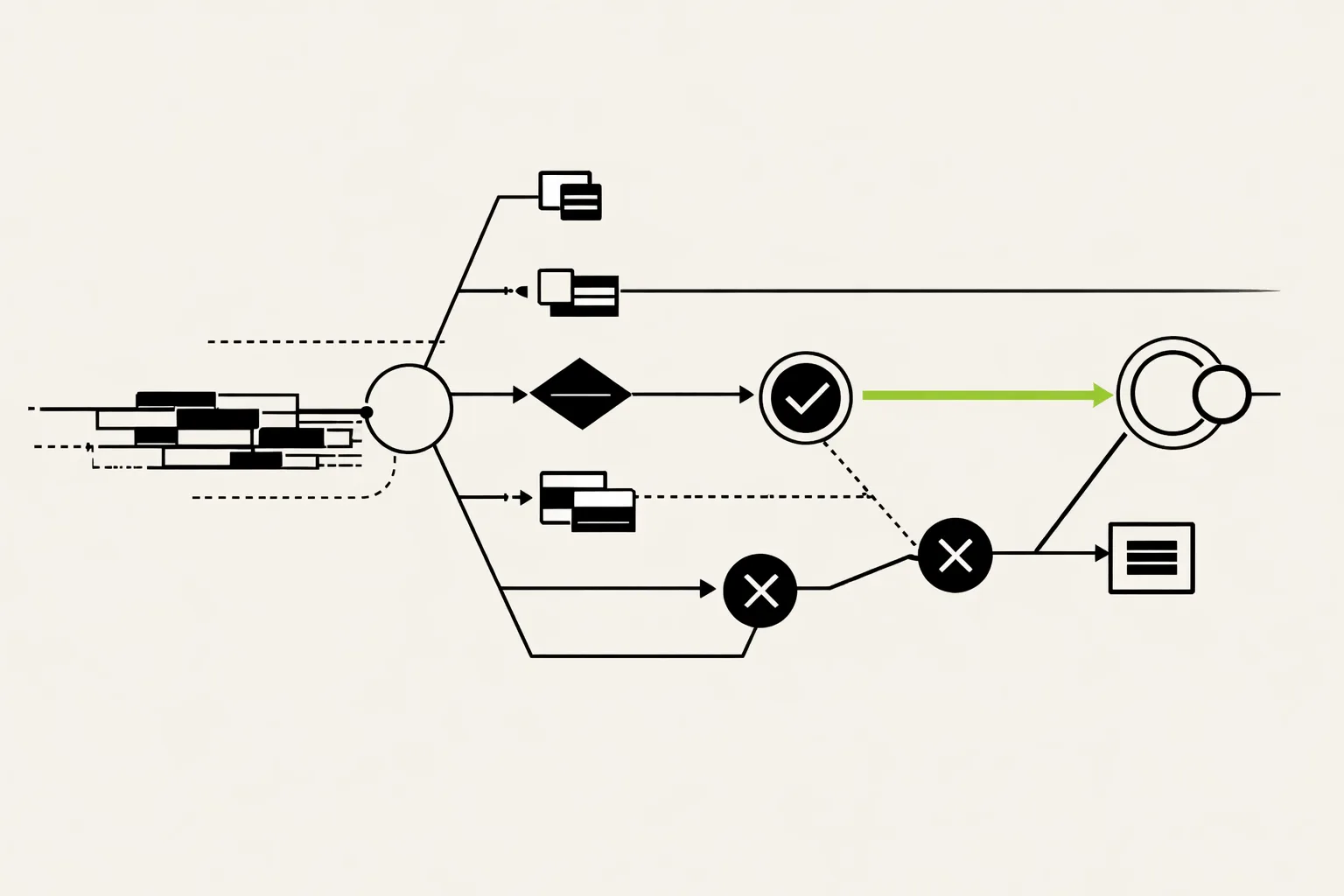
A streaming interface makes an AI application feel alive: text appears quickly, a tool call takes shape, and a user can interrupt a long-running task. That visible responsiveness is useful. It is also easy to mistake it for a simple UI concern.
It is not. Once a model can stream text, request tools, pause for approval, reconnect after a dropped connection, or return a result after the last visible token, the client is handling a distributed interaction. The application needs to know not merely what arrived, but what it means, whether it is complete, and what can safely happen next.
That is the job of streaming state management: explicitly modeling, accumulating, validating, recovering, and completing state delivered through a partial event stream. It is an engineering umbrella rather than a rigid industry standard. Teams may describe pieces of it as event accumulation, resumable clients, stream lifecycle management, or durable workflows. The important idea is consistent: do not treat streamed events as a sequence of display updates. Treat them as transitions in a state machine.
Plain English: A streaming client should not ask only, “What should I show now?” It should also ask, “What state is this operation in, and is it safe to act?”
Why this matters now
A conventional request-response API gives a comforting, if imperfect, boundary: send one request, receive one result, then decide what to do. Streaming breaks that boundary into many observations. A text fragment may be harmless to render. A partial tool argument is not safe to execute. A disconnect may mean the server continued working, or it may mean neither side knows whether an outbound message arrived.
OpenAI’s Python SDK 3.20.0 made this reality more concrete on September 28, 2026. The release added opt-in incremental WebSocket text and tool snapshots, retained detailed WebSocket accumulator snapshots, and addressed uncertain replay and caller-queue handling. The release notes are implementation-specific, but the engineering lesson travels: partial progress, outbound ownership, and recovery are correctness concerns, not polish work.
The OpenAI Agents SDK makes the lifecycle similarly explicit. Its documentation distinguishes semantic events, completion, cancellation, interruptions, resumable state, and final output; it also notes that a stream can continue event consumption and post-processing after the last visible token. Streaming documentation and result documentation therefore argue against using “the text stopped” as a completion signal.
This matters most when an agent has consequences beyond chat. A coding agent may prepare a change, a support agent may draft a customer update, or an operations agent may request a privileged action. In all three cases, the user-facing stream is only one view of a larger operation. Conflating that view with committed application state creates races, duplicate effects, and confusing recovery behavior.
Model the operation before handling its events
Start with a lifecycle that your application owns. Exact names vary, but a useful model might include connecting, receiving, awaiting_approval, executing_tool, cancelling, cancelled, failed, and completed. The value is not the vocabulary. The value is making legal transitions explicit.
For example, a user pressing Stop can move a run into cancelling; it should not automatically become cancelled just because the UI stopped rendering tokens. The client may still need to consume terminal information, release resources, reconcile a pending tool request, or persist a recoverable record. Likewise, a visible final sentence does not necessarily justify moving to completed until the provider declares final completion and any required local post-processing has finished.
Next, accumulate events into typed domain state. A semantic event describes something meaningful to the application: a message delta, a completed tool request, an approval interruption, or a final result. A transport event describes delivery mechanics: a WebSocket frame, a reconnect, a timeout, or a retry. They influence each other, but they are not interchangeable.
Text deltas can generally be appended to provisional display text. Tool-call fragments need a stricter path: collect identifiers and argument fragments, parse only when the relevant completion condition has arrived, validate against the tool’s schema, then decide whether execution is authorized. A partially formed JSON object is evidence that data is arriving, not permission to call a database or deployment API.
Plain English: Text can be shown while it is incomplete. Actions should wait until the application has a complete, validated, authorized request.
A snapshot is the next useful boundary. It captures the current logical state—such as accumulated text, known tool-call fields, lifecycle position, and pending approval—so a client can restore its understanding without assuming that replaying raw frames will reconstruct reality. The SDK’s detailed accumulator snapshots illustrate the value of retaining this structured intermediate state. OpenAI’s release notes do not make snapshots a universal recovery guarantee; they show why clients need explicit recovery material.
Then define what happens around connections. A reconnect is not a semantic restart. Ask four questions for every outbound message: who owns it now; was it merely attempted or confirmed; may it be retried; and what happens if it is delivered twice? The SDK’s fixes around uncertain replay, attempted sends, and caller queues underline why “reconnect and resend everything” is unsafe. The relevant release notes describe this as a practical transport problem, not an abstract edge case.
Finally, make terminal conditions provider-aware. A final visible token, a socket close, a tool result, and a completed run are distinct signals. Build an adapter that maps the provider’s event identities and guarantees to your internal lifecycle. That prevents provider-specific quirks from leaking throughout the UI and business logic.
What it is not
Streaming state management overlaps with several established ideas, but it is not a new name for any one of them.
Event sourcing is a persistence architecture in which an authoritative, durable event log reconstructs state. It can be a strong foundation for stream recovery, but streaming state management can also use snapshots, short-lived in-memory state, or a conventional database. Its defining concern is correct live accumulation and recovery, not a prescribed storage model.
It is also narrower than stream processing. Stream-processing systems usually compute over continuing flows of records—telemetry, clicks, orders, logs. Here the unit of concern is commonly one interactive run with unusual boundaries: incomplete tool input, approval pauses, cancellation, a connection replacement, and a terminal result.
Nor is it the same as durable execution. A durable workflow engine persists progress across failure and may offer checkpointing or replay guarantees. Streaming state management can sit inside such an engine, but it still needs rules for provisional output, semantic completion, connection recovery, and side effects.
Finally, logging and observability are necessary but insufficient. Logs tell you what appears to have happened. State management decides what the application accepts as authoritative, what it can resume, and whether it may execute an action.
Example: a streamed deployment assistant
Consider a hypothetical internal deployment assistant. It streams an explanation of a proposed rollout, gathers tool-call arguments for a deployment request, and requires an engineer’s approval before execution.
The UI can render message fragments immediately, marked as provisional. Separately, the client accumulates the tool-call identifier and arguments in typed state. If the connection drops after the client sends approval, it must not blindly approve again on reconnect. The original approval may have reached the service, or it may not have. The correct recovery path depends on a durable run identifier, a query for current run state when available, and an explicit policy for an unresolved acknowledgement.
When the run pauses, store a snapshot containing the pending interruption and the approved-or-unapproved decision state. The Agents SDK documents this pattern: a streamed run can pause for tool approval, become resumable state, receive a resolution, and continue. Its human-in-the-loop documentation provides the provider-specific lifecycle surface; your application still owns authorization and recovery policy.
When the deployment tool finally runs, the tool itself needs idempotency: repeated requests with the same operation identity must not create repeated external effects. A snapshot can restore client state; it cannot make a deployment exactly once. The effectful boundary needs its own deduplication or idempotency-key strategy.
Plain English: Recovering the screen is not the same as recovering the operation. Any action with an external effect needs its own duplicate-protection plan.
Where it breaks
This pattern adds discipline, but it does not erase uncertainty. If server-side state was not retained, a client cannot reconstruct it from wishful replay. The Agents SDK documents WebSocket reuse, connection limits, reconnect behavior, and cases where locally managed state is needed to recover a chain after reconnect. Its running-agents documentation is a reminder to understand the recovery limits of the specific runtime.
Snapshots can also become stale or incompatible as event schemas evolve. Backpressure—the condition where events arrive faster than a consumer can safely process them—can make a client retain too much state or render misleading lag. And an intermediate model response may be wrong, revised, or unsafe even when transport is perfect. Keep a sharp distinction between provisional display state and committed business state.
The common failure is overconfidence. Teams see a continuous text stream, write an append-only renderer, and call it done. That works until the first tool call, reconnect, cancellation, or approval flow turns a presentational feature into a transactional system.
What a senior engineer can do this week
Pick one streamed route and draw its lifecycle. Include disconnects, user cancellation, tool approval, provider completion, and cleanup. If the diagram cannot answer whether a tool may run after reconnect, the implementation probably cannot either.
Then separate your code into three layers: a transport adapter, a typed accumulator, and application policy. The adapter normalizes provider events. The accumulator builds domain state and snapshots. Policy decides authorization, retry, rendering, and side effects. This separation makes provider changes and tests much less invasive.
Test ugly sequences deliberately: duplicate deltas, missing terminal events, delayed tool fragments, socket closure after an attempted send, cancellation during a tool call, and a completed run that arrives after the UI appears finished. Track time to first delta separately from time to semantic completion and cleanup. Those are different user and operational experiences.
Most importantly, reserve the word “complete” for a defined, testable state transition. In streaming AI systems, that small semantic discipline is what keeps a pleasant live interface from becoming an unreliable control plane.